A criminal record rarely tells a simple story. For many people, one arrest led to multiple charges, amended counts, a dismissal on one allegation, and a plea or conviction on another. When that happens, the question is no longer just whether a person can pursue record sealing in Nevada. The real question is how those overlapping results affect eligibility, timing, and the best way to approach the legal process.
That matters because a record with multiple convictions or multiple cases can affect daily life in ways a single-count case may not. Employers, landlords, licensing boards, and others reviewing court records or background checks may see more than one arrest, more than one conviction, or a mix of dismissed and guilty counts that still create confusion.
Under Nevada law, having several charges does not automatically mean a person is disqualified. In fact, some people with a more complicated criminal history may still qualify to have all eligible records sealed through one coordinated filing, especially when the charges arose in the same county and can be presented to the proper court together.
The challenge is that Nevada does not treat every charge the same. Some misdemeanor offenses carry shorter waiting periods, some felony convictions require a longer wait, and some serious felonies or sexual offenses cannot be sealed through the ordinary statute at all. When several charges appear on the same record, the analysis becomes more exact, not less.
For that reason, people searching for criminal records expungement or asking how to expunge records often start from the wrong legal framework. Nevada generally provides record sealing, not traditional expungement, and the rules focus on whether the person, the charge, and the elapsed time satisfy the statutory requirements.
How Multiple Charges Influence Record Sealing Eligibility: A Change in the Analysis
When a case includes multiple charges stemming from a crime, the court does not simply look at the most favorable count and ignore the rest. Nevada’s sealing statutes require a charge-by-charge and case-by-case review of the final disposition, the sentence, and the waiting period attached to each offense. Multiple charges can significantly impact your criminal record, making the sealing process more complex.
Many jurisdictions limit sealing to individuals with two or fewer total convictions, often restricting felony convictions to one. Having multiple charges often complicates the sealing process and can disqualify individuals entirely in some jurisdictions.
That means one dismissed count does not erase a separate guilty plea, and one low-level misdemeanor does not necessarily shorten the waiting period attached to a related felony. A person may have one part of the record that is ready now and another part that still must wait.
In practice, this is where many filings go wrong. People see that one charge was dismissed and assume the whole case can be sealed immediately, or they see one conviction and assume every count must wait for the longest possible period. Nevada law is more nuanced than that. Charges that were dismissed or resulted in acquittal are often easier to seal than actual convictions.
The state’s 2023 legislation is especially important here. The Nevada Legislature revised NRS 179.255 so that when a person faced multiple charges arising from the same arrest or criminal proceeding, and some ended in conviction while others were dismissed, declined, or resulted in acquittal, the person may petition to seal the non-conviction records without waiting for the conviction-based counts to become eligible.
That change is significant because it can make part of a complex record eligible sooner than expected. It does not automatically clear the whole file, but it can remove dismissed allegations from public access while the convicted counts continue to run through their own waiting periods.

How Nevada Courts Evaluate Eligibility When There Are Multiple Convictions or Multiple Cases
Nevada’s main conviction-sealing statute, NRS 179.245, ties eligibility to the exact offense and the time that has passed since release from custody or discharge from probation or parole. So when a person has multiple convictions, the court must evaluate each eligible offense under its own timeline.
Many states set strict limits on the total number of convictions allowed for sealing, often only permitting two convictions with one felony, and courts have discretion to seal up to two convictions, only one of which may be a felony.
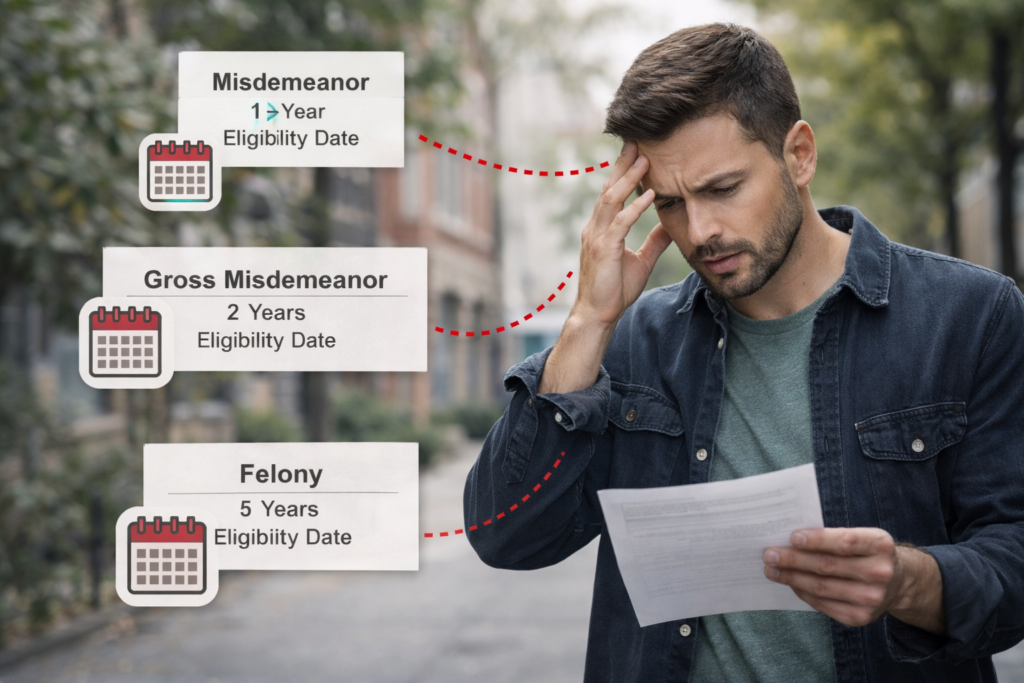
Some minor convictions become eligible relatively quickly. Many ordinary misdemeanors may be petitioned after one year, while some misdemeanor-level offenses, such as certain battery, harassment, stalking, or protection-order violations, require longer. Gross misdemeanors and Category E felonies also follow their own timelines.
More serious offenses, such as felony convictions, require more patience. Many Category B, C, and D felonies generally carry a five-year waiting period, while Category A felonies, crimes of violence, and residential burglary generally require ten years. Waiting periods, often 10+ years, typically start from the latest conviction or release date, and the required waiting period typically begins only after the final disposition or release for the most recent conviction. If a person has several convictions across these levels, the record may become sealable in stages rather than all at once.
That does not mean a person must always bring separate proceedings forever. In Clark County, the District Court has jurisdiction over district, justice, and municipal court criminal charges for sealing purposes, and county guidance explains that one set of papers can include all charges to be sealed within Clark County.
Still, the fact that charges may be submitted together does not merge their legal standards. The judge still has to determine whether each count is actually eligible, whether the required time has passed, whether all fines and court costs have been paid, and whether the petition properly identifies all records related to the cases.
Why Timing Becomes More Complicated With Multiple Charges
The biggest timing mistake is assuming the clock starts on the plea or sentencing date. Under Nevada’s statute, the waiting period generally runs from release from actual custody or discharge from supervision, not simply from the day a person was found guilty or sentenced. In fact, the ten-year period for sealing records starts from the date of conviction or release from prison, whichever is later.
That matters in multi-count cases because one charge may have involved probation, another may have involved community service, and another may have been resolved by dismissal. The result is that each part of the record can sit on a different legal timeline.
A person with old misdemeanor convictions and one newer felony may discover that some counts are ready now, while the felony still delays the sealing of that separate conviction. Likewise, a person who had a deferred disposition or another specialized resolution may need the underlying paperwork reviewed carefully before assuming the record is ready. It is also important to review whether you may be eligible to expunge records, which is a related but distinct legal process from sealing, with its own eligibility criteria and procedural steps.
This is why careful sequencing matters. In some situations, it makes strategic sense to file petitions for the ready counts rather than wait for every charge on a lifetime record to line up at once. In others, one coordinated filing is more efficient. The correct approach depends on the cases, the jurisdiction, and the exact dispositions involved.
Nevada also has a rebuttable presumption in favor of sealing when the statutory requirements are met. But that presumption still depends on a correct petition, correct timelines, and an accurate description of each charge. A strong filing is legal work, not clerical guesswork.
The Record Sealing Process for Multiple Charges and Multiple Cases
The process starts with the criminal history itself. Nevada’s official guidance says a current, verified criminal history and relevant court records must be obtained before preparing the petition and order, because the court and reviewing agencies need an accurate list of arrests, dispositions, and custodians.
That requirement is especially important when there are multiple cases. A person may have records held by the police department, the sheriff’s office, the court, and state repositories. If those agencies are not properly identified, the order may not fully reach every place where the record appears.
Clark County’s guidance explains that the filing may first go through the district attorney’s office as part of the stipulation process. The petitioner prepares the paperwork and submits it with the appropriate attachments, including the verified criminal history and other supporting documents.
Some records may be automatically sealed through automatic sealing procedures if certain statutory conditions are met, meaning they are automatically sealed by law without the need for an individual petition. Otherwise, if the matter is not resolved by stipulation, there may be a hearing. Nevada’s statute allows the prosecuting authority and other interested persons to present evidence, and the court then decides whether the requested sealing should be granted or denied.
After a sealing application is approved, the petitioner receives a court-signed Seal Order (court order), which must be verified with the appropriate state agency. The petitioner must also provide a copy of the petition to the attorney for the Commonwealth, who may object or not within 30 days; if an objection is filed, the court may conduct a hearing on the petition for sealing.
In some counties or case types, practical filing details also matter. The correct court clerk, the right court form, and whether the matters belong in the same court can all affect how efficiently the petition moves. Clark County specifically notes that the District Court can handle charges from several lower courts within the county for sealing purposes.
A person may only have two petitions for sealing granted in their lifetime under certain jurisdictions, and this may apply if the charges arose from different transactions or occurrences.
People should also expect administrative costs. Nevada’s guidance discusses obtaining a verified criminal history, and county-level procedures may involve local filing practices and possible court fees, court costs, or copy charges, even though the exact amount depends on the case and court.
The processes for expungement and sealing of records are similar, but the outcomes are significantly different. Expungement destroys the record, while sealed records prohibit public access but allow certain agencies, such as law enforcement and the sheriff’s office, to view them. Sealed records are generally not accessible to employers, which can help individuals move forward with employment opportunities. Expunged convictions are treated as if they never happened.
Given the complexity of these procedures and the importance of proper filing, consulting attorneys is highly recommended to ensure compliance with all requirements and to maximize the chances of a successful outcome.
What Multiple Charges Do Not Automatically Prevent
Having more than one charge does not automatically mean the record cannot be sealed. Nevada law does not impose a blanket rule that a person with several arrests or convictions is forever barred from relief. The question is whether the specific offenses qualify and whether the statutory waiting periods have been satisfied. Almost all jurisdictions require that applicants have no active or pending criminal cases at the time of application.
It also does not mean every count must stay public just because one count still needs more time. Thanks to the recent statutory change, some dismissed or acquitted charges from a mixed-disposition case may be addressed earlier, even when another count from the same arrest resulted in a conviction. Eligibility for sealing may also depend on the ‘successful completion’ of a deferred prosecution agreement or similar program, as required by law.
At the same time, people should not overread that rule. Some convictions cannot be sealed through the ordinary statute at all, including certain serious felonies and specified sexual offenses. Additionally, violations of emergency protective orders, hate crimes, offenses involving the possession and distribution of flunitrazepam, cases where the person was found not guilty by reason of insanity, conspiracy, attempt, or solicitation for ineligible offenses, and offenses where the victim was a family or household member are not eligible for sealing. When those appear anywhere in the record, a lawyer should evaluate the file carefully before any broad promises are made.
The court has discretion to approve or deny petitions for sealing criminal records based on various factors, including evidence of rehabilitation. In some cases, federal law requires specific procedures for record retention, disclosure, or sealing, which may impose additional requirements beyond state law.
Nevada also generally uses sealing rather than true expungement. So even after a court signs a sealing order, the relief is best understood as restricting public dissemination of the record, not wiping history from existence under federal law or every other system everywhere.
That distinction matters in daily life. A sealing order can meaningfully improve employment prospects, housing opportunities, and allow many people to answer common background questions more safely, but it is still important to understand the legal limits and the contexts in which sealed files may still be accessible.

FAQ About How Multiple Charges Influence Record Sealing Eligibility
Can I seal dismissed charges from the same arrest if I was convicted on another count?
Yes, in many situations. Nevada’s revised NRS 179.255 allows a person facing mixed outcomes from the same arrest or criminal proceeding to petition to seal the dismissed, declined, or acquitted charges without having to wait for the conviction counts to become eligible.
Do multiple convictions automatically make me ineligible for record sealing in Nevada?
No. Multiple convictions do not automatically bar relief. The court looks at the offense level, the waiting period, and whether each conviction qualifies under Nevada’s sealing statute.
Can I include multiple cases in one petition?
Often, yes. In Clark County, District Court guidance says one set of documents may include all charges to be sealed within the county, even when they came from district, justice, or municipal courts.
What usually causes a multi-charge petition to be denied or delayed?
Common problems include filing before the waiting period has run, misidentifying the charges or agencies holding the records, and submitting incomplete supporting documents. Accuracy matters more, not less, when a record includes several arrests or counts.
Conclusion
When a record includes multiple charges, the path to record sealing becomes more technical, but it does not disappear. Nevada law allows many people with mixed outcomes, multiple convictions, or multiple cases to pursue relief if the charges are eligible, the waiting periods have passed, and the petition is prepared with care.
The safest next step is to have the whole record reviewed as one legal story, not as disconnected paperwork. If you want clear answers about whether your charges qualify, whether you should file now, and how to strengthen your request with the right evidence and documents, contact a Nevada record sealing lawyer for a confidential free consultation and get guidance tailored to your specific record.